Istoria sistemelor de ruletă
Două secole de oameni care au scris reguli pentru schimbarea mizei.
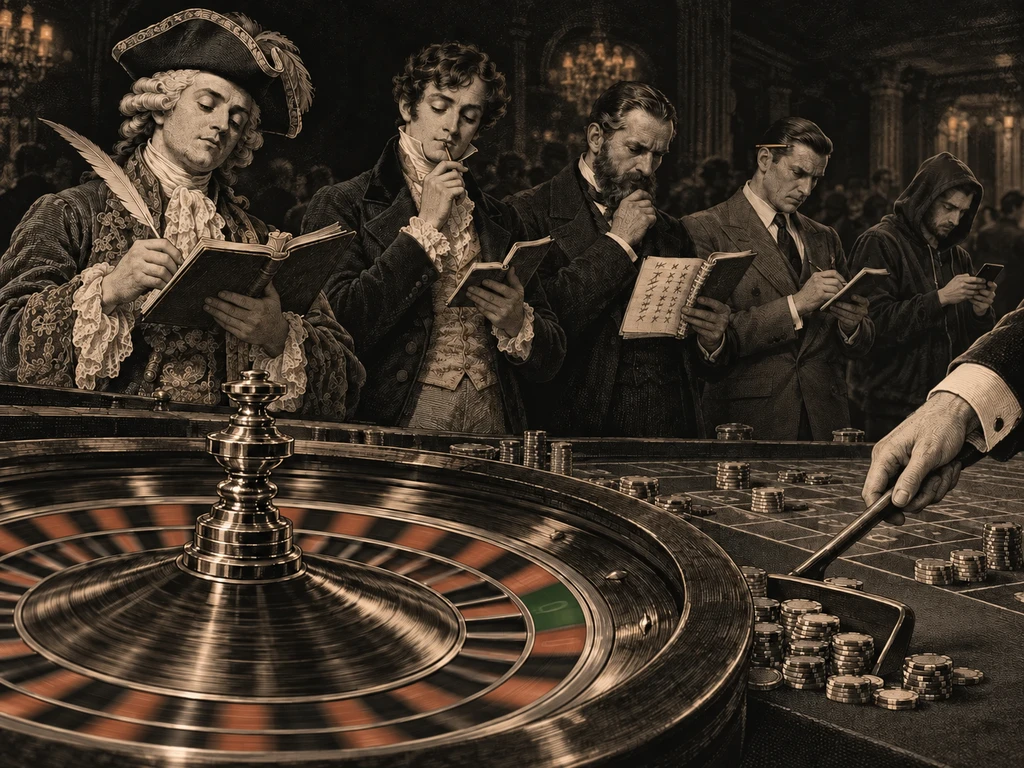
Martingale este din secolul al XVIII-lea; D’Alembert poartă numele unui matematician căruia nu îi plăcea; Labouchère este hobby-ul unui politician victorian. Niciunul nu a funcționat nici atunci.
Martingale
The 1762 Académie française dictionary records martingalestrategieMartingaleProgresie care dublează pariul după fiecare pierdere. Vezi secțiunea Strategie pentru ce face și ce nu face.Citește tot → as a gambling term for staking what has been lost. Its 1878 edition explicitly describes doubling after a loss and also uses the word more broadly for betting schemes. These entries document usage; they do not identify a single inventor.
Today the familiar doubling progressionstrategieProgresieOrice regulă care schimbă miza în funcție de rezultatele anterioare. Progresiile negative o măresc după pierderi, cele pozitive după câștiguri.Citește tot → aims to recover previous losses and gain one starting unitbaniUnitateMiza de bază în care lucrează un sistem sau un jucător. Progresiile sunt descrise în unități ca să se aplice la orice masă.Citește tot → when a win arrives. A finite bankrollbaniBuget de jocSuma totală pusă deoparte pentru joc. Gestionarea bugetului înseamnă să decizi cât din el riști pe pariu și pe sesiune.Citește tot → or table limitmasăLimita meseiPariul minim și pariul maxim permise. Maximul este cel care oprește progresiile cu dublare.Citește tot → can stop the sequence first. The Strategy section shows how those limits affect a session.
D’Alembert
The progression bearing d’Alembert’s name raises the stake by one unit after a loss and lowers it after a win. The name alone does not prove who devised or endorsed the betting rule.
Its mathematical issue is straightforward: on independent spinsmatematicăRotiri independenteFiecare rotire are aceleași probabilități, indiferent de istoric. Baza fiecărui calcul de pe acest site.Citește tot →, a run of one outcome does not make the opposite outcome due. A famous namesake does not change that assumption or the payoutbaniPlatăCe aduce un pariu câștigător, exprimat ca „X la 1”, pe lângă miza returnată.Citește tot →.
Labouchère
The cancellation system uses a list of numbers to determine the next stake. A win removes entries and a loss adds an entry; the Strategy section sets out the rules and examples. Historical stories about its namesake should be distinguished from evidence that the method creates an advantage.
A sequence may clear with a profit, but a losing run can leave a growing list and larger required stakes. How often it clears depends on the starting list, bankroll, limits and stopping rule. There is no universal success percentage.
Secolul al XX-lea
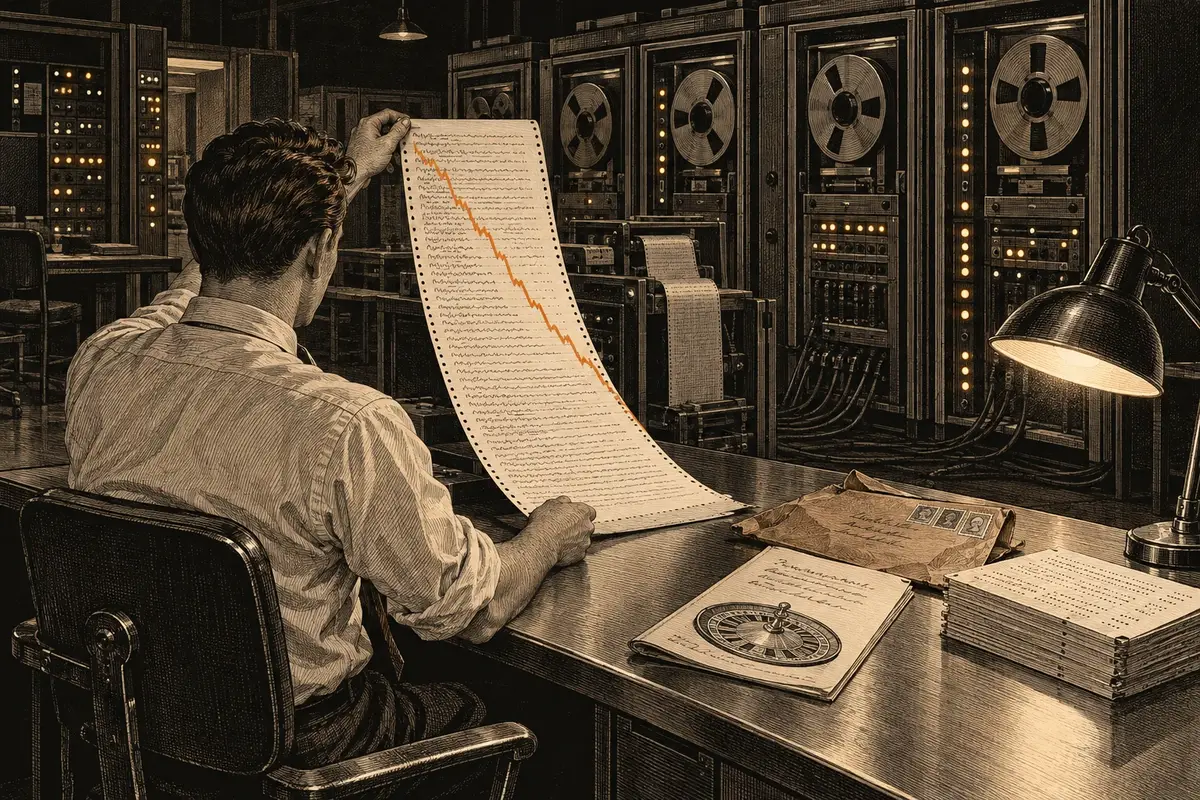
A simulation can show how a specified system behaves under a chosen wheel model. It cannot test every possible rule, and a finite run need not return exactly the theoretical house edgematematicăAvantajul caseiPartea din fiecare miză pe care cazinoul o păstrează în medie: 2,70% la ruleta europeană.Citește tot →.
For independent uniform single-zeroroatăZeroSingurul buzunar verde, pe care nu îl acoperă niciun pariu pe șanse simple, pe duzină sau pe coloană; sursa avantajului casei. Se mai numește: un singur zero, 0.Citește tot → spins with standard full-loss-on-zero payouts, each unit staked has expected net return −1/37. For a bounded session whose stakes are chosen using information available before each spin, adding the conditional expectations gives expected lossmatematicăPierdere așteptatăValoarea așteptată înmulțită cu suma totală pariată; suma pierdută în medie pe durata unei sesiuni sau a unei perioade.Citește tot → equal to 1/37 of expected turnoverbaniRulajSuma totală pariată pe durata unei sesiuni sau a unei perioade, incluzând câștigurile pariate din nou. Se mai numește: handle, action.Citește tot →. Stopping or changing stakes can change the distribution of results, but not create positive expectation under those assumptions. Other payouts, such as la partageregulăLa partageRegulă franceză: când iese zero, jumătate dintr-o miză pe șanse simple este returnată. Înjumătățește avantajul casei la aceste pariuri, până la 1,35%.Citește tot →, need their own calculation.
Mit: o strategie la ruletă care câștigă mereuStrategia Fibonacci la ruletă
De ce supraviețuiesc
A demonstration can end in profit without showing that the method has an edge. Some rules favor frequent small wins at the cost of occasional large losses; others do the reverse. The proportions depend on the exact rules and limits.
When comparing systems, look at all completed sessions, total stakes, losses and stopping conditions. A selected winning example leaves out the information needed to assess the claim.
Sisteme de vânzare
Systems have also been sold with elaborate names and entry rules. The examples below illustrate the arithmetic of specific rules; they are not evidence of who first invented or marketed them. Waiting for a pattern does not alter the next independent spin’s probabilities.
Cel care nu este un sistem
Regulile de oprire: hotărârea dinainte a cât să pierzi sau să câștigi și plecarea. Sunt adesea vândute ca parte dintr-un sistem și sunt singura parte care face ceva, pentru că reduc rulajul. Nu au un omonim, ceea ce se potrivește.
Întrebări
Martingale, cu un secol sau mai mult. Dublarea după o pierdere este prima idee pe care o are oricine.
D’Alembert a fost cel mai aproape, din greșeală. Pascal, Fermat, Huygens, Bernoulli și Laplace au explicat toți de ce eșuează.
Pentru că majoritatea sesiunilor câștigă, iar un video cu o sesiune câștigătoare este ieftin de făcut.
Pauză de umor
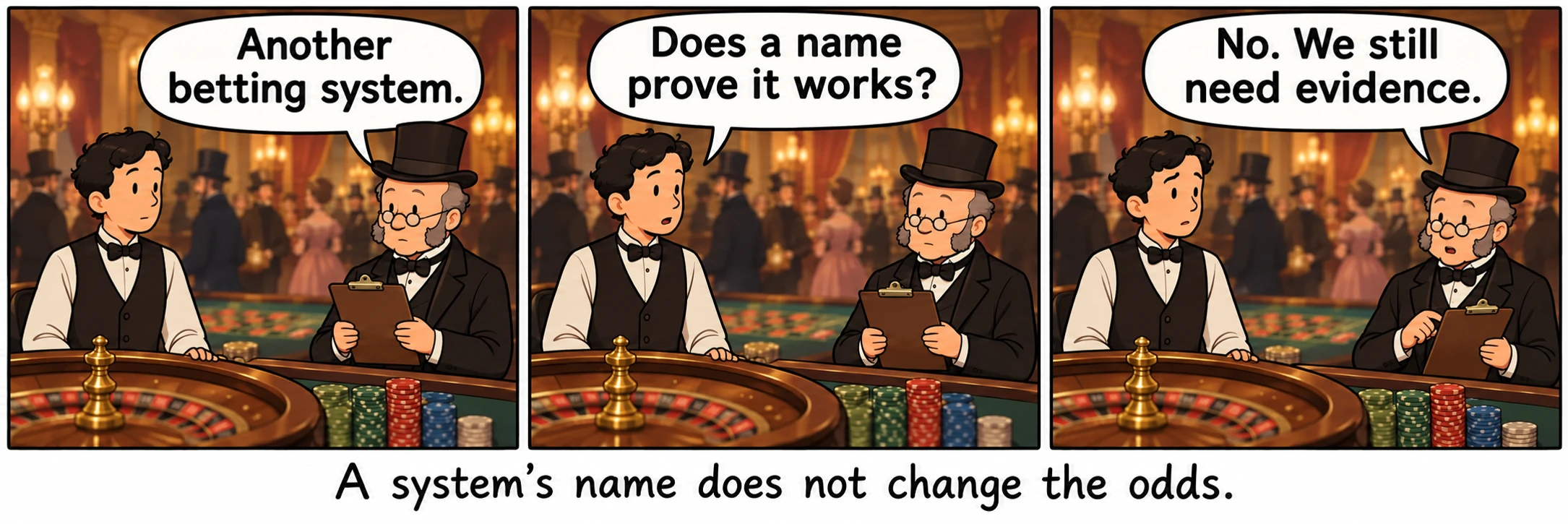
Două secole de nume. Un singur număr.
Surse
- Thorp, E. O. “Optimal gambling systems for favorable games.”
- Thorp, E. O. The Mathematics of Gambling.
- Doob, J. L. “Note on probability.”
- Halmos, P. R. “Invariants of certain stochastic transformations: the mathematical theory of gambling systems.”
- d’Alembert, J. “Croix ou pile.”
- Schwartz, D. G. Roll the Bones: The History of Gambling.
- Kavanagh, T. M. Dice, Cards, Wheels: A Different History of French Culture.
- Bollman, M. Mathematics of the Big Four Casino Table Games: Blackjack, Baccarat, Craps, & Roulette.
- Académie française, martingale, 1762
- Académie française, martingale, 1878