Pierderea așteptată
House edgematematicăAvantajul caseiPartea din fiecare miză pe care cazinoul o păstrează în medie: 2,70% la ruleta europeană.Citește tot → times the amount wagered: how to calculate expected loss.

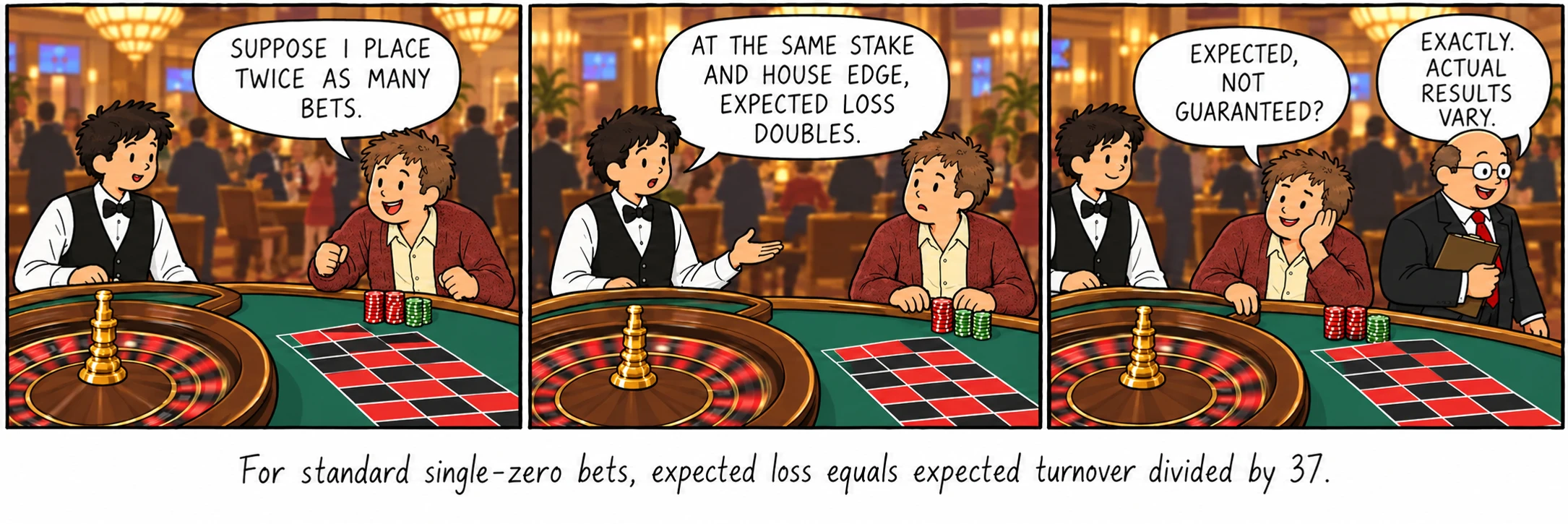
Pierderea așteptată = total pariat × 1/37. Miză de $10, 100 de rotiri: $1.000 pariați, $27 pierdere așteptată. Progresiile pariază mai mult, deci pierd mai mult.
Rulajul, nu bugetul
Expected lossmatematicăPierdere așteptatăValoarea așteptată înmulțită cu suma totală pariată; suma pierdută în medie pe durata unei sesiuni sau a unei perioade.Citește tot → depends on how much passes across the table, not on how much you brought. Completing $2,000 of standard single-zeroroatăZeroSingurul buzunar verde, pe care nu îl acoperă niciun pariu pe șanse simple, pe duzină sau pe coloană; sursa avantajului casei. Se mai numește: un singur zero, 0.Citește tot → bets gives an expected loss of $54.05. A $100 starting bankrollbaniBuget de jocSuma totală pusă deoparte pentru joc. Gestionarea bugetului înseamnă să decizi cât din el riști pe pariu și pe sesiune.Citește tot → might or might not last long enough to complete that turnoverbaniRulajSuma totală pariată pe durata unei sesiuni sau a unei perioade, incluzând câștigurile pariate din nou. Se mai numește: handle, action.Citește tot →. A single $10,000 bet on redpariuRoșuȘansă simplă pe cele 18 numere roșii. În franceză: rouge.Citește tot → has an expected loss of $270.27. These are averages, not deductions or limits on the actual loss.
Formula
For a fixed schedule of standard single-zero bets, E[loss] = total stakes / 37. With stakes or stopping times that depend on earlier results, expected loss is expected turnover / 37, provided expected turnover is finite. The table shows fixed-stake examples, assuming all 100 spins are completed. ProgressionstrategieProgresieOrice regulă care schimbă miza în funcție de rezultatele anterioare. Progresiile negative o măresc după pierderi, cele pozitive după câștiguri.Citește tot → averages require a specified bankroll, limit, stopping rule and simulation or calculation.
Ritmul
Mesele live merg cu 40–60 de rotiri pe oră, sălile de cazinou cu 30–50, mesele rapide cu 90 sau mai multe, iar mesele RNG cu viteza cu care dai clic. La aceeași miză, ritmul este cea mai mare pârghie a pierderii așteptate pe oră: trecerea de la o masă lentă dintr-o sală la o masă RNG jucată cu 200 de rotiri pe oră face costul serii de patru ori mai mare, fără nicio schimbare a șanselor.
Într-un an
At 50 spins per hour, two hours per week and $10 per spin for 52 weeks, total turnover is $52,000. Expected loss is about $1,405 on standard single-zero bets, $703 on la partageregulăLa partageRegulă franceză: când iese zero, jumătate dintr-o miză pe șanse simple este returnată. Înjumătățește avantajul casei la aceste pariuri, până la 1,35%.Citește tot → even-money betspariuȘansă simplăRoșu/negru, impar/par, mare/mic. 18 numere, plătește 1:1.Citește tot →, or $2,737 on standard double-zero bets other than the five-number bet. These figures assume every scheduled bet is made. Fewer bets, smaller stakes or a lower edge reduce expected loss; actual results remain uncertain.
Un joc care valorează mai mult decât orice bancă
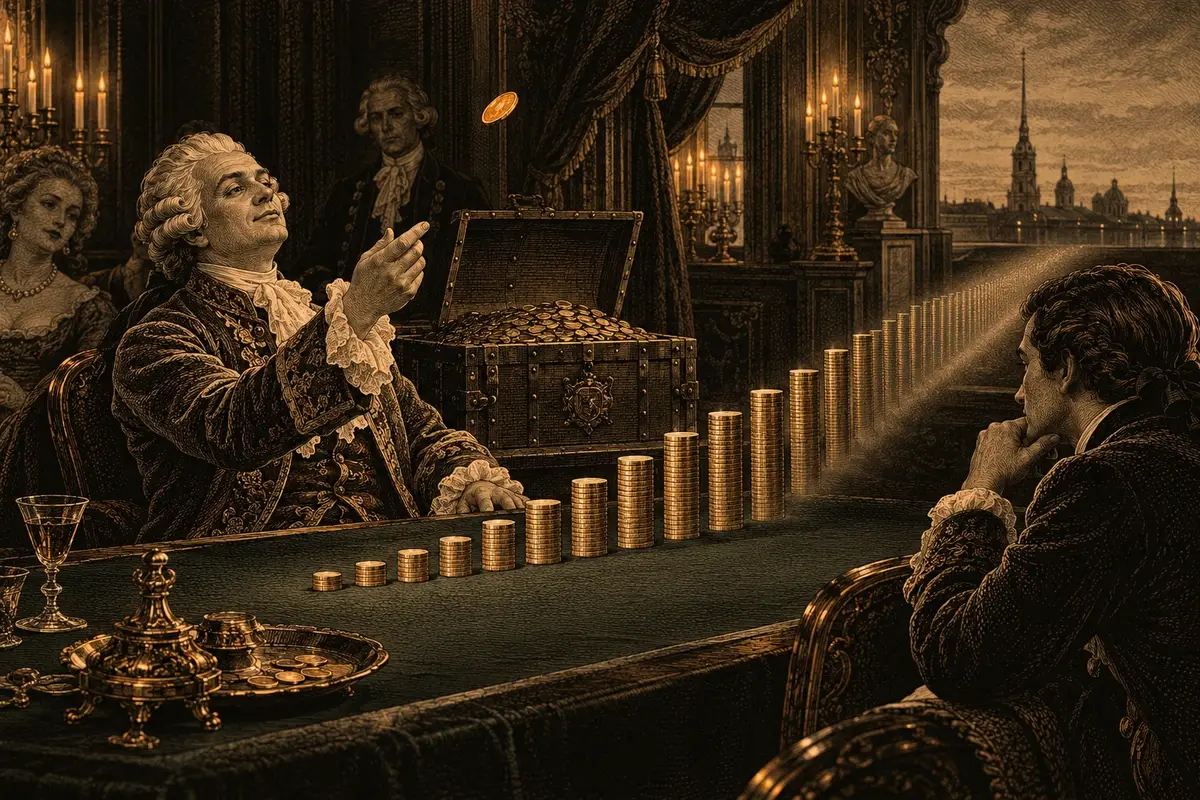
The St. Petersburg game, posed by Nicolaus Bernoulli in 1713, tosses a coin until it lands heads and pays $2 if that takes one toss, $4 if two, $8 if three, doubling each time. Every possible length adds $1 to the expected valuematematicăValoare așteptatăRezultatul mediu pe pariu pe termen lung. −1/37 din miză pentru orice pariu european standard.Citește tot →, so on paper the game is worth an infinite amount. No bank can pay infinite prizes, and once the prizes are capped at what the bank holds, the value collapses: with a bank of $1 million the game is worth about $21, with $1 billion about $31. The comparison with MartingalestrategieMartingaleProgresie care dublează pariul după fiecare pierdere. Vezi secțiunea Strategie pentru ce face și ce nu face.Citește tot → is the importance of limits: a theoretical doubling sequence can require stakes beyond any finite bankroll or table limitmasăLimita meseiPariul minim și pariul maxim permise. Maximul este cel care oprește progresiile cu dublare.Citește tot →. That does not make the two games identical. A failed progression need not lose the entire bankroll, and a short session can finish ahead.
Pierderea așteptată nu este rezultatul
A single session can differ greatly from its expected loss. For 100 independent standard single-zero even-money bets at $10 each, the net result has a standard deviationmatematicăAbatere standardRădăcina pătrată a varianței; distanța tipică a unui rezultat față de valoarea așteptată.Citește tot → of about $99.96 and an expected value of −$27.03. A winning session is possible. Expected loss describes the average across repeated sessions under those assumptions; it is neither a fee nor a limit on what one session can lose.
Formulă
Întrebări
No fixed percentage is deducted from your buy-inmasăBuy-inSchimbarea banilor numerar în jetoane la masă. Se face între rotiri, cu banii puși pe tabloul de joc, nu dați în mâna crupierului.Citește tot →. For standard bets on a fair single-zero wheel, expected loss is about 2.70% of the amount wagered. Actual results vary. Re-betting winnings adds to the amount wagered.
With the same rules and number of bets, a smaller fixed stake lowers expected loss. The probabilitymatematicăProbabilitateȘansa unui rezultat, de la 0 la 1 sau de la 0% la 100%. Un număr: 1/37 = 2,70%.Citește tot → of reaching a profit target is a different question and also depends on bankroll, stake and stopping rules.
Cazinourile îți estimează pierderea așteptată din pariul mediu și din timpul jucat și îți returnează o fracțiune din ea sub formă de gratuități. Îți restituie o parte din preț, nu îți dau un avantaj.
Pauză de umor
Rulaj × 1/37. Ceasul e în formulă.
Surse
- Ethier, S. N. The Doctrine of Chances: Probabilistic Aspects of Gambling.
- Epstein, R. A. The Theory of Gambling and Statistical Logic, 2nd ed.
- Taylor, D. G. Games, Gambling, and Probability: An Introduction to Mathematics, 2nd ed.